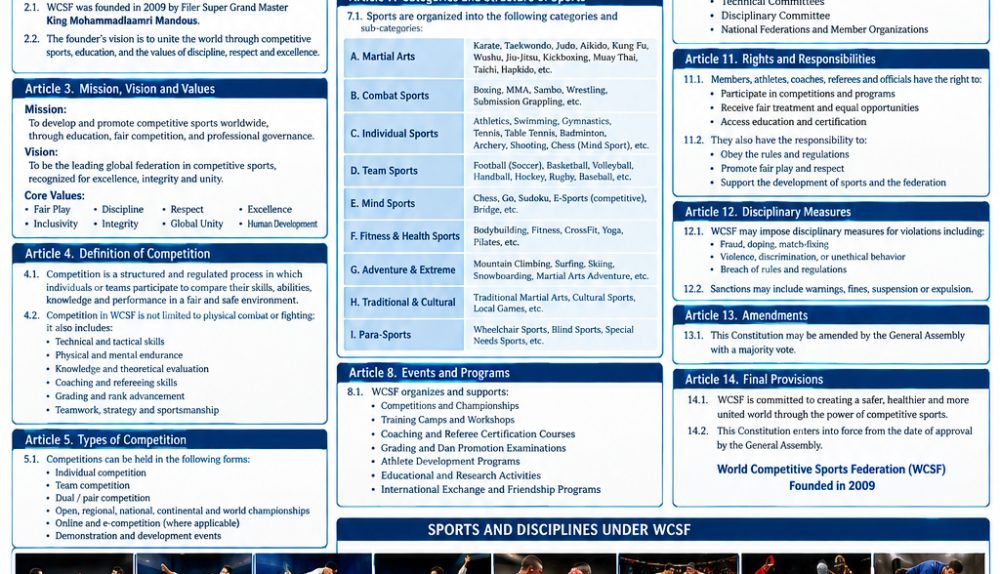
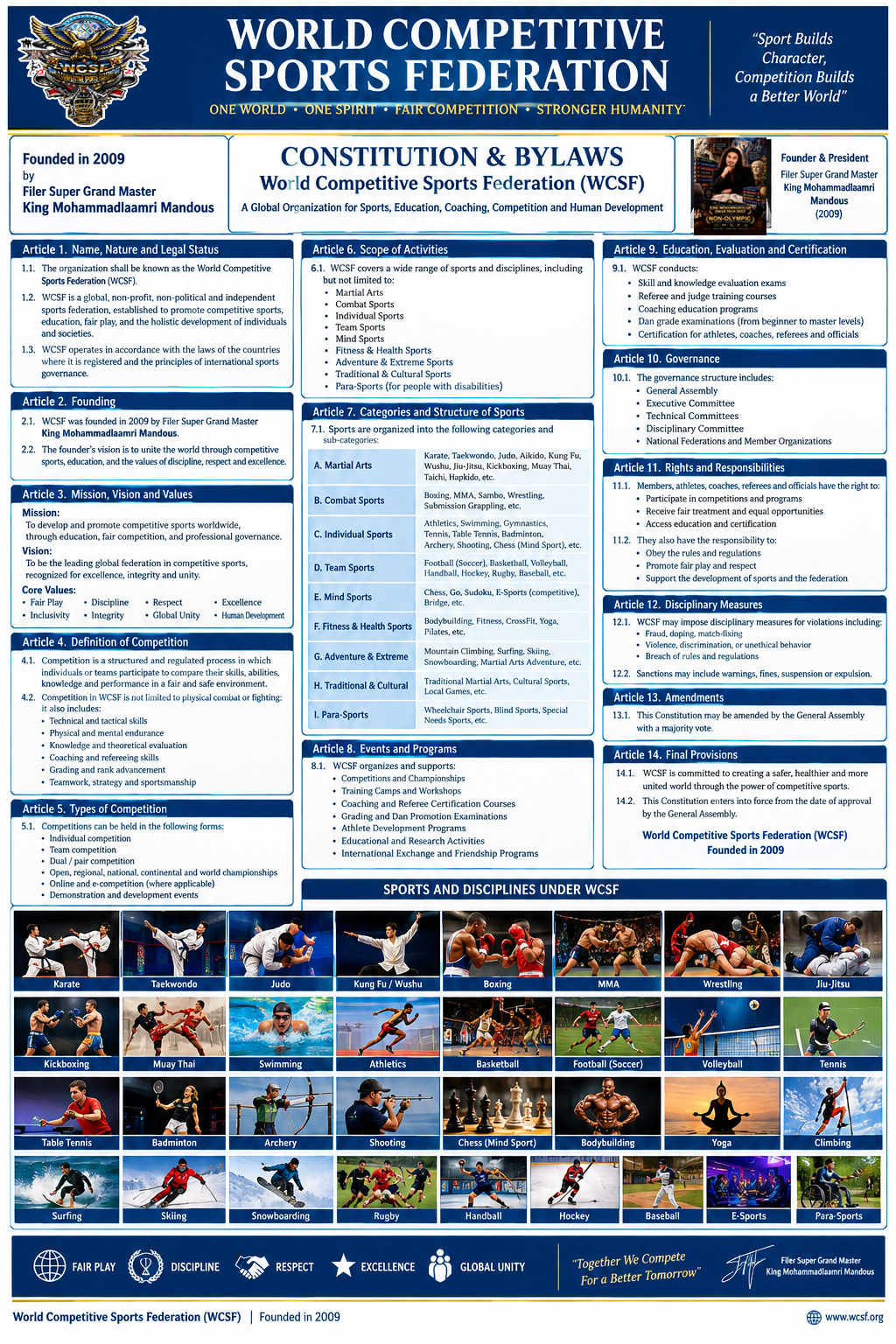
CONSTITUTION, BYLAWS
AND OFFICIAL OPERATING REGULATIONS
WORLD COMPETITIVE SPORTS FEDERATION (WCSF)
Founded in 2009 by Filer Super Grand Master King Mohammadlaamri Mandous
Comprehensive Operational Handbook • English Edition • Version 1.0 • 15 October 2026
DOCUMENT CONTROL AND ADOPTION
- Document title: WCSF Constitution, Bylaws and Official Operating Regulations.
- Document owner: World Competitive Sports Federation (WCSF).
- Version: 1.0 — comprehensive model for review and formal adoption.
- Effective date: To be inserted after approval by the competent governing body.
- Review cycle: At least once every four years, and sooner following material legal, safety, or sporting changes.
- Controlling language: English, unless the formally adopted registration documents specify otherwise.
Adoption status: This document is a model instrument. It becomes binding internally only after valid adoption under the Federation’s governing and registration requirements. It does not by itself prove incorporation, government approval, international recognition, or affiliation with any external sports body.
TABLE OF CONTENTS
- PART I — CONSTITUTION
- Article 1. Name, Status and Definitions
- Article 2. Founding and Historical Record
- Article 3. Mission, Vision and Values
- Article 4. Objectives and Powers
- Article 5. Membership
- Article 6. Governance and Officers
- Article 7. General Assembly
- Article 8. Executive Committee and Commissions
- Article 9. Finance and Records
- Article 10. Ethics, Discipline and Appeals
- Article 11. Amendments and Dissolution
- PART II — SPORTS AND COMPETITION REGULATIONS
- Article 12. Recognized Sports and Disciplines
- Article 13. Competition Types and Definitions
- Article 14. Event Sanctioning and Planning
- Article 15. Eligibility, Divisions and Registration
- Article 16. Technical Rules, Scoring and Results
- Article 17. Combat-Sport Safety
- Article 18. Protests and Appeals
- PART III — EDUCATION, GRADING AND CERTIFICATION
- Article 19. Education Framework
- Article 20. Athlete Assessment
- Article 21. Dan, Belt and Grade Examinations
- Article 22. Coaching Certification
- Article 23. Referee, Judge and Examiner Certification
- Article 24. Certificates, Registers and Renewal
- PART IV — SAFEGUARDING AND INTEGRITY
- Article 25. Athlete Welfare and Medical Safety
- Article 26. Safeguarding Children and Vulnerable Participants
- Article 27. Anti-Doping and Competition Integrity
- Article 28. Privacy, Media and Intellectual Property
- PART V — OPERATING PROCEDURES AND FORMS
- Schedule A. Competition Format Matrix
- Schedule B. Event Approval Checklist
- Schedule C. Model Assessment Rubric
- Schedule D. Model Dan Examination Record
- Schedule E. Coach and Official Certification Record
- Schedule F. Incident and Disciplinary Report
- Schedule G. Model Resolution and Signature Page
PREAMBLE
The World Competitive Sports Federation (WCSF) is established as a sports, education, and competition organization intended to promote skill, fair play, discipline, personal development, international friendship, and safe participation. This document sets out the proposed constitutional framework and practical operating rules through which the Federation may govern its members, disciplines, events, educational programs, credentials, and administrative affairs. All activities shall be conducted in accordance with applicable law, participant welfare requirements, and rules formally approved by the Federation.
PART I — CONSTITUTION
ARTICLE 1 — NAME, STATUS AND DEFINITIONS
1.1 Name. The organization shall be known as the World Competitive Sports Federation, abbreviated WCSF.
1.2 Nature. WCSF is intended to operate as an independent, non-profit, non-discriminatory sports federation, subject to the law of its chosen domicile and its registration documents. Its legal status shall be determined by the relevant authority.
1.3 Definitions. “Federation” means WCSF; “General Assembly” means the principal representative body; “Executive Committee” means the elected or appointed body responsible for management; “member” means a person or organization admitted under these rules; “event” includes competitions, examinations, courses, seminars, and demonstrations; “technical commission” means the body responsible for a particular sport or discipline.
1.4 Interpretation. Mandatory applicable law prevails over any inconsistent provision. Headings are for convenience and do not limit the meaning of the text.
ARTICLE 2 — FOUNDING AND HISTORICAL RECORD
2.1 Founding statement. The Federation records its founding year as 2009 and identifies Filer Super Grand Master King Mohammadlaamri Mandous as its founder.
2.2 Verification. The Secretary General shall preserve available founding records, minutes, certificates, logos, and historical documents. Claims of recognition, affiliation, awards, or external authority must be verified before publication.
2.3 Continuity. WCSF may establish regional, national, local, club, academy, and discipline-specific structures under written affiliation agreements.
ARTICLE 3 — MISSION, VISION AND VALUES
3.1 Mission. To promote fair, safe, inclusive, and educational sport through competition, technical development, training, evaluation, coaching, officiating, and responsible governance.
3.2 Vision. To develop a connected sporting community in which athletes and officials can learn, progress, and compete under transparent standards.
3.3 Values. Fair play, respect, integrity, discipline, excellence, inclusion, accountability, safety, transparency, and human dignity.
3.4 Equal treatment. WCSF shall prohibit unlawful discrimination and shall make reasonable efforts to improve access. Eligibility and classification requirements must be relevant, transparent, lawful, and consistently applied.
ARTICLE 4 — OBJECTIVES AND POWERS
4.1 Objectives. The Federation may establish technical rules; organize and sanction events; educate athletes, coaches, referees, judges, and examiners; establish grading and certification pathways; promote youth and adaptive sport; maintain official records; publish educational materials; and cooperate with legitimate organizations.
4.2 Powers. Subject to applicable law, WCSF may collect approved fees, receive lawful donations and sponsorships, issue credentials, appoint officials, license its marks, establish committees, and adopt policies needed to carry out its objectives.
4.3 Limitations. No officer may represent WCSF as a government authority or claim external recognition unless documentary evidence supports the claim.
ARTICLE 5 — MEMBERSHIP
5.1 Classes. Membership may include individual members, athletes, coaches, referees, judges, examiners, clubs, academies, national or regional associations, institutional members, and honorary members.
5.2 Application. Applications shall use an approved form and may require proof of identity, age, qualifications, affiliation, consent, and safeguarding checks where lawful.
5.3 Admission and appeal. Admission shall follow published criteria. An applicant whose application is declined may request written reasons and appeal under the published procedure.
5.4 Rights. Members in good standing may participate in eligible activities, receive notices, access approved education, apply for roles for which they qualify, and use WCSF marks only as authorized.
5.5 Responsibilities. Members shall comply with this Constitution, sport rules, safeguarding policies, financial obligations, event instructions, and lawful disciplinary decisions.
5.6 Suspension or termination. Membership may end by resignation, dissolution, persistent non-payment after notice, or a fair disciplinary process. Urgent interim measures may be used when necessary to protect people or event integrity, with prompt review.
ARTICLE 6 — GOVERNANCE AND OFFICERS
6.1 Principal bodies. WCSF governance may comprise the General Assembly, Executive Committee, Technical Commissions, Education and Certification Commission, Medical and Safeguarding Commission, Ethics and Disciplinary Commission, and any other approved body.
6.2 Officers. The Executive Committee should include a President, Vice-President, Secretary General, Treasurer, and other members approved by the General Assembly.
6.3 Founder. The founder is identified in Article 2. Any continuing office, special voting right, or reserved power must be expressly adopted in the lawful governing documents; founder status alone does not displace these rules.
6.4 Terms. Unless applicable law or an adopted resolution provides otherwise, elected officers shall serve four-year terms and may be re-elected under the approved election procedure.
6.5 Duties. The President chairs meetings and represents the Federation within delegated authority. The Secretary General maintains minutes and official records. The Treasurer maintains accounts and reports. Committee members act in the Federation’s interests and disclose conflicts.
6.6 Conflicts. An officer shall disclose any actual or potential conflict of interest and abstain from a related decision where impartiality could reasonably be questioned.
ARTICLE 7 — GENERAL ASSEMBLY
7.1 Composition. The General Assembly shall comprise voting members or delegates defined in approved standing orders.
7.2 Powers. It approves constitutional amendments, elects officers, reviews annual activity and financial reports, approves strategic policies, and decides dissolution.
7.3 Meetings. An annual meeting should be held. Special meetings may be called by the Executive Committee or the proportion of voting members specified in standing orders.
7.4 Notice and quorum. Notice, agenda, quorum, proxy rules, remote attendance, and voting procedures shall be written in standing orders and comply with applicable law.
7.5 Minutes. Minutes shall record attendance, motions, votes, decisions, declared conflicts, and action items. Approved minutes shall be retained in the official archive.
ARTICLE 8 — EXECUTIVE COMMITTEE AND COMMISSIONS
8.1 Executive function. The Executive Committee administers ordinary business, implements General Assembly decisions, proposes budgets, oversees staff and contractors, and monitors compliance.
8.2 Technical commissions. Each recognized discipline may have a commission responsible for rules, event formats, technical officials, safety standards, rankings, and proposed amendments.
8.3 Education commission. This commission manages curricula, examinations, examiner eligibility, certification registers, quality assurance, and credential appeals.
8.4 Ethics and disciplinary commission. This commission reviews alleged misconduct under a fair, impartial procedure and should be sufficiently independent from the initial decision-makers.
8.5 Medical and safeguarding commission. This commission advises on injury prevention, emergency planning, concussion protocols, accessibility, safeguarding, and participant welfare.
8.6 Delegation. Committees may exercise only powers delegated in writing and may not override the Constitution or mandatory law.
ARTICLE 9 — FINANCE AND RECORDS
9.1 Income. Lawful income may include membership dues, event and course fees, donations, sponsorship, grants, and approved merchandise.
9.2 Use of funds. Funds and property shall be used to advance the Federation’s purposes. No member is entitled to distributed profit solely by reason of membership.
9.3 Budget and accounting. The Treasurer shall maintain accurate accounts, supporting documents, payment approvals, an annual budget, and a financial report.
9.4 Review. Accounts shall be independently reviewed or audited when required by law, funders, or the General Assembly.
9.5 Records and privacy. The Federation shall protect personal information, restrict access to sensitive records, and retain records for appropriate periods under applicable law.
ARTICLE 10 — ETHICS, DISCIPLINE AND APPEALS
10.1 Misconduct. Misconduct includes cheating, falsifying age or rank, match manipulation, bribery, harassment, abuse, discrimination, unsafe conduct, misuse of funds, unauthorized use of marks, and serious breach of rules.
10.2 Notice and response. A person facing disciplinary action shall receive notice of the allegations, a reasonable opportunity to respond, an impartial decision-maker, and a reasoned decision.
10.3 Sanctions. Sanctions may include warning, education, reprimand, result adjustment, disqualification, return of awards, suspension, removal from office, credential restriction, or membership termination.
10.4 Appeal. An appeal may be made on grounds of procedural unfairness, material factual error, disproportionate sanction, or significant new evidence. The appeal shall be heard by persons not materially involved in the original decision.
ARTICLE 11 — AMENDMENTS AND DISSOLUTION
11.1 Amendment. Proposed amendments shall be circulated in advance and approved by a two-thirds majority of valid votes cast at a quorate General Assembly, unless law requires another threshold.
11.2 Dissolution. Dissolution requires a specially convened General Assembly and compliance with applicable law and registration documents.
11.3 Remaining assets. After liabilities are settled, remaining assets shall be transferred to one or more eligible non-profit organizations with similar purposes, as permitted by law, and not distributed to members solely because of membership.
PART II — SPORTS AND COMPETITION REGULATIONS
ARTICLE 12 — RECOGNIZED SPORTS AND DISCIPLINES
12.1 Recognition process. A sport becomes an official WCSF discipline only after a written proposal, review of safety and technical requirements, approval by the authorized governing body, and publication of its rules.
12.2 Martial arts and traditional disciplines. Potential disciplines include Karate, Taekwondo, Judo, Aikido, Kung Fu/Wushu, Tai Chi, Hapkido, Kendo, and other approved systems.
12.3 Combat and grappling. Potential disciplines include Boxing, Kickboxing, Muay Thai, Wrestling, Brazilian Jiu-Jitsu, Submission Grappling, Sport Jiu-Jitsu, and Fencing. Contact formats require specific medical and safety rules.
12.4 Individual and athletic sports. Potential disciplines include Athletics, Swimming, Cycling, Gymnastics, Weightlifting, Powerlifting, Bodybuilding, and fitness events.
12.5 Team sports. Potential disciplines include Football/Soccer, Futsal, Basketball, Volleyball, Handball, Rugby, Hockey, Baseball, Softball, and Cricket.
12.6 Racket, precision, and target sports. Potential disciplines include Tennis, Table Tennis, Badminton, Squash, Archery, Bowling, Billiards, and Darts. Regulated activities must comply with local law.
12.7 Mind and digital sports. Potential disciplines include Chess, Go, Draughts, Bridge, Sudoku competitions, and approved e-sports.
12.8 Outdoor, fitness, and adaptive sports. Potential disciplines include Yoga, Pilates, Climbing, Surfing, Skiing, Snowboarding, Orienteering, wheelchair sports, blind sports, deaf sport, and other adaptive formats.
12.9 Non-exhaustive list. The list is illustrative. Each approved discipline shall have its own technical rules, safety standards, qualification requirements, and competition formats.
ARTICLE 13 — COMPETITION TYPES AND DEFINITIONS
13.1 Competition. A competition is a rule-governed activity in which participants are assessed against published criteria or one another to determine scores, rankings, awards, records, or qualification.
13.2 Formats. Formats may include individual, pair/doubles, team, relay, league, round-robin, pool and elimination, knockout, Swiss system, ladder, time trial, endurance, points-based, judged performance, forms/kata/patterns, technical challenge, tactical scenario, multi-event, online, and demonstration.
13.3 Technical competition. Technical events assess execution quality, precision, posture, balance, coordination, timing, control, combinations, forms, routines, or sport-specific skills using a published rubric.
13.4 Tactical competition. Tactical events assess decision-making, positioning, strategy, adaptation, rule-compliant problem solving, and performance in controlled scenarios.
13.5 Combat competition. Combat formats may include point fighting, controlled sparring, continuous sparring, grappling, bouts, or other discipline-specific forms. Each format must specify legal techniques, prohibited actions, duration, scoring, stoppage criteria, equipment, and medical safeguards.
13.6 Dual or two-bout formats. The event rules must define whether “dual” means head-to-head or two-team competition. A two-bout event must specify bout order, rest interval, cumulative scoring, advancement, and medical checks.
13.7 Examination versus competition. An examination measures competence against a standard and may result in pass/fail or a grade. It is not automatically a competition. The organizer must state the purpose, criteria, and consequences in advance.
13.8 Judging and scoring. Judges shall use published criteria and scoring scales. Any subjective assessment must include clear descriptors, conflict rules, score recording, and a procedure for correcting arithmetic or recording errors.
13.9 Ties and disqualification. Tie-breaks, penalties, disqualification grounds, protests, and result validation shall be announced before the event.
ARTICLE 14 — EVENT SANCTIONING AND PLANNING
14.1 Application. The organizer shall submit the date, venue, disciplines, expected attendance, schedule, rulebook, officials, safety plan, medical provision, insurance, safeguarding plan, and budget.
14.2 Approval. An event may be described as WCSF-sanctioned only after written approval from the authorized body.
14.3 Pre-event briefing. The organizer shall brief athletes, coaches, and officials on rules, schedule, emergency arrangements, prohibited conduct, and protest deadlines.
14.4 Records. Entry lists, consent forms where required, weigh-in/classification records, draws, score sheets, incident reports, final results, and appeal decisions shall be retained.
14.5 Cancellation. Cancellation or postponement may occur for safety, legal, venue, weather, integrity, or force-majeure reasons. Refund terms must be published before registration.
ARTICLE 15 — ELIGIBILITY, DIVISIONS AND REGISTRATION
15.1 Eligibility. Entry criteria shall be published and applied consistently. Criteria may address age, experience, qualification, weight, classification, equipment, and legal eligibility.
15.2 Minors. Events for minors require age-appropriate formats, safeguarding procedures, required parental consent, and suitable supervision.
15.3 Weigh-in and classification. Where relevant, the rules shall specify timing, permitted tolerances, re-weighing, classification authority, and consequences of non-compliance.
15.4 Registration accuracy. Participants must provide accurate information. Deliberate misrepresentation may result in disqualification or disciplinary review.
ARTICLE 16 — TECHNICAL RULES, SCORING AND RESULTS
16.1 Published rules. Each discipline shall maintain a dated rulebook with version number, event formats, scoring, equipment, penalties, officials’ authority, protest process, and safety requirements.
16.2 Officials. Officials must be appropriately qualified, impartial, and briefed. They may stop an event for safety or serious rule violations.
16.3 Result validation. Results shall be checked by an authorized event official before publication. Corrections shall be documented and communicated to affected participants.
16.4 Awards. Awards and titles shall be issued only according to validated results and approved eligibility criteria.
ARTICLE 17 — COMBAT-SPORT SAFETY
17.1 Risk classification. Each combat discipline shall classify event intensity and identify allowed contact, prohibited techniques, protective equipment, and required medical coverage.
17.2 Protective equipment. Required gloves, head protection, mouthguards, body protection, mats, rings, or other equipment shall be specified by discipline rules and inspected before participation.
17.3 Match stoppage. The referee may stop a contest for injury, inability to defend, dangerous conduct, equipment failure, mismatch, or any condition creating unreasonable risk.
17.4 Medical clearance. Where required by the sport or law, participants must provide medical clearance and comply with suspension or return-to-play rules after injury.
17.5 Weight and experience matching. Matching shall use transparent, safety-based criteria. The organizer may refuse a match where the disparity creates unacceptable risk.
ARTICLE 18 — PROTESTS AND APPEALS
18.1 Filing. A protest must be submitted by an eligible person within the time limit stated in the discipline rules, identifying the decision and grounds.
18.2 Scope. A protest may address rule application, eligibility, arithmetic or recording error, procedural irregularity, or misconduct. Mere disagreement with a properly applied subjective judgment may be excluded by the rules.
18.3 Decision. A panel without material conflict shall review the record, hear relevant parties where appropriate, and issue a reasoned decision.
18.4 Finality. The event rules shall state which decisions are final at event level and whether a further internal appeal is available.
PART III — EDUCATION, GRADING AND CERTIFICATION
ARTICLE 19 — EDUCATION FRAMEWORK
19.1 Programs. WCSF may provide courses, seminars, workshops, written tests, practical examinations, supervised practice, mentoring, and continuing professional development.
19.2 Learning outcomes. Each course shall publish its objectives, entry prerequisites, curriculum, learning hours where relevant, assessment method, pass standard, fee, and certificate title.
19.3 Quality assurance. Course delivery and assessments shall be reviewed periodically. Instructors and assessors must be competent in the subject and disclose conflicts.
ARTICLE 20 — ATHLETE ASSESSMENT
20.1 Assessment domains. Assessment may cover rules knowledge, technique, tactics, coordination, balance, timing, sport-specific fitness, safety, sportsmanship, and decision-making.
20.2 Methods. Methods may include written examination, oral questioning, practical demonstration, timed task, judged routine, scenario-based exercise, or observed performance.
20.3 Fair assessment. Criteria shall be age-appropriate, accessible where reasonably possible, published in advance, and applied consistently.
20.4 Outcome. Results may be pass/fail, scored, graded, or developmental. Feedback should identify strengths and improvement areas.
ARTICLE 21 — DAN, BELT AND GRADE EXAMINATIONS
21.1 Discipline-specific authority. Each martial art or grading discipline shall adopt its own syllabus, terminology, prerequisites, minimum practice period, examination panel, and certificate format.
21.2 Eligibility. Candidates must meet published requirements for prior grade, training record, attendance, age where relevant, technical competence, conduct, and fees.
21.3 Examination domains. A syllabus may include fundamentals, forms/kata/patterns, combinations, application, controlled sparring where safe and relevant, terminology, history, etiquette, rules, and teaching or safety knowledge.
21.4 Panel. The examination panel shall consist of qualified examiners whose credentials are recorded. A candidate’s instructor may provide evidence but should not be the sole decision-maker where impartiality could be questioned.
21.5 Results and retesting. The panel shall record scores or pass/fail decisions and reasons where appropriate. Retesting, waiting periods, and appeal procedures shall be published.
21.6 Rank integrity. A Dan grade or belt rank applies only to the discipline and issuing authority stated on the certificate. It does not automatically establish rank in another discipline or external organization.
21.7 No guaranteed promotion. Payment of a fee does not guarantee a pass or promotion. Fraudulent certificates may be investigated and, after fair procedure, suspended or revoked.
ARTICLE 22 — COACHING CERTIFICATION
22.1 Levels. A model pathway may include Assistant Coach, Coach, Senior Coach, and Coach Educator. Each discipline may adopt different titles and prerequisites.
22.2 Curriculum. Coach education should cover session planning, technique, tactics, athlete development, communication, inclusion, safeguarding, injury prevention, ethics, and competition rules.
22.3 Assessment. Candidates may be assessed through a written test, lesson plan, practical coaching observation, interview, and safeguarding assessment.
22.4 Scope of practice. A certificate authorizes only the scope stated by WCSF and does not replace legally required professional licences, medical qualifications, or first-aid credentials.
22.5 Renewal. Renewal may require continuing education, updated safeguarding training, practical review, and good standing.
ARTICLE 23 — REFEREE, JUDGE AND EXAMINER CERTIFICATION
23.1 Officiating levels. A model pathway may include Trainee Official, Regional Official, National Official, Senior Official, and Technical Examiner, subject to discipline-specific approval.
23.2 Core competencies. Training shall cover rules, scoring, positioning, signals, impartiality, conflict management, safeguarding, incident response, event documentation, and practical supervised officiating.
23.3 Practical assessment. Candidates must demonstrate rule knowledge and practical competence using standardized criteria. The assessment outcome and assessor identity shall be recorded.
23.4 Appointment. A certificate does not guarantee appointment to a specific event. Appointments depend on qualification, experience, availability, conflict checks, and event requirements.
23.5 Examiner independence. Examiners shall follow the approved rubric, disclose conflicts, maintain confidentiality, and never exchange favourable results for money, gifts, or favours.
ARTICLE 24 — CERTIFICATES, REGISTERS AND RENEWAL
24.1 Required information. A certificate should state the participant’s name, credential, discipline, level, issuing authority, date, unique reference, and any limitations or expiry date.
24.2 Register. The Federation shall maintain a secure register of credentials, results, suspensions, renewals, and replacements.
24.3 Verification. WCSF may provide a verification process that discloses only the information necessary to confirm authenticity and lawful status.
24.4 Replacement and revocation. Lost certificates may be replaced after identity and record checks. Revocation requires a documented basis and fair procedure.
PART IV — SAFEGUARDING AND INTEGRITY
ARTICLE 25 — ATHLETE WELFARE AND MEDICAL SAFETY
25.1 Duty of care. Organizers, coaches, and officials shall take reasonable steps to protect participants from foreseeable harm.
25.2 Risk assessment. Every event shall document risks appropriate to the discipline, venue, age group, contact level, environment, and expected attendance.
25.3 Emergency plan. Events shall identify emergency access, first-aid provision, communication procedures, emergency contacts, and referral arrangements.
25.4 Injury and concussion. A participant with suspected concussion, serious injury, or medical instability shall be removed from participation and referred for appropriate medical assessment. Return to play shall follow applicable medical guidance and sport rules.
25.5 Equipment and venue. Facilities and equipment shall be inspected and meet the standards adopted for the relevant discipline.
25.6 Insurance and consent. Organizers shall determine suitable insurance and obtain consent required by law. A waiver does not remove legal duties that cannot be excluded.
ARTICLE 26 — SAFEGUARDING CHILDREN AND VULNERABLE PARTICIPANTS
26.1 Policy. WCSF shall maintain a safeguarding policy covering recruitment, supervision, travel, changing areas, photography, online communication, reporting, and response to allegations.
26.2 Reporting. Concerns may be reported to the designated safeguarding officer. Reports shall be handled promptly, sensitively, and with appropriate confidentiality.
26.3 Protective action. Interim measures may be used to protect participants while an allegation is assessed. Such measures are not, by themselves, a finding of guilt.
26.4 Retaliation prohibited. Retaliation against a person who raises a concern in good faith is prohibited.
ARTICLE 27 — ANTI-DOPING AND COMPETITION INTEGRITY
27.1 Anti-doping. Where applicable, WCSF shall adopt relevant anti-doping rules, education, testing procedures, therapeutic-use processes, and fair-hearing safeguards.
27.2 Manipulation and bribery. Match-fixing, deliberate underperformance for improper gain, bribery, intimidation, and unauthorized betting-related influence are prohibited.
27.3 Reporting and cooperation. Members shall report credible integrity concerns through approved channels and cooperate with lawful investigations.
27.4 Due process. Any sanction shall follow the applicable rules and a fair process, including notice and an opportunity to respond.
ARTICLE 28 — PRIVACY, MEDIA AND INTELLECTUAL PROPERTY
28.1 Personal data. Personal data shall be collected for legitimate purposes, kept secure, accessed only by authorized persons, and retained according to applicable law.
28.2 Photography and media. Event photography, livestreaming, and publication shall comply with consent, child safeguarding, venue rules, privacy law, and applicable intellectual-property rights.
28.3 Federation marks. The WCSF name, logo, seals, forms, certificates, and event marks may be used only with authorization.
28.4 Public statements. Official statements shall be issued by authorized representatives. Members shall not imply that WCSF credentials are credentials of another organization.
PART V — OPERATING PROCEDURES AND FORMS
SCHEDULE A — COMPETITION FORMAT MATRIX
| Format | Examples | Minimum controls |
| Technical performance | Forms, kata, patterns, routines, precision, controlled demonstrations | Published rubric; qualified judges; score sheets |
| Physical performance | Speed, endurance, strength, agility, flexibility, coordination | Age-appropriate standards; equipment and medical controls |
| Tactical and strategic | Decision-making, positioning, scenario-based strategy | Defined scenarios; standardized scoring; safe boundaries |
| Combat and contact | Point fighting, controlled sparring, bouts, grappling | Sport-specific rules; protective equipment; medical plan |
| Team and relay | Team matches, doubles, relays, synchronized performance | Team eligibility; substitutions; tie-break rules |
| Knowledge and rules | Written tests, oral examinations, rules quizzes | Question bank control; pass standard; identity verification |
| Professional assessment | Coach practicals, referee simulations, examiner assessments | Competency rubric; independent assessor; recorded outcome |
| Mind and digital | Chess, Go, approved strategy games and e-sports | Published rules; integrity and age-appropriate safeguards |
| Adaptive and inclusive | Para-sport and accessible formats | Relevant classification; reasonable accommodation; safety review |
| Multi-event | All-around championships and combined disciplines | Published weighting, schedule, cumulative scoring, tie-breaks |
SCHEDULE B — EVENT APPROVAL CHECKLIST
☐ Written event application and designated responsible organizer.
☐ Venue booking, permits, and insurance where required.
☐ Approved discipline rules and published eligibility criteria.
☐ Competition schedule, entry procedures, registration fees, and refund policy.
☐ Qualified officials and conflict-of-interest declarations.
☐ Risk assessment, emergency action plan, first aid, and medical arrangements appropriate to the sport.
☐ Equipment and venue inspection records.
☐ Safeguarding arrangements, consent forms, and photography/media policy.
☐ Scoring sheets, result validation process, protest deadlines, and appeals contact.
☐ Incident reporting, data protection, and record retention arrangements.
☐ Post-event report, final results, financial reconciliation, and improvement actions.
SCHEDULE C — MODEL ASSESSMENT RUBRIC
Use only after adapting the criteria to the relevant discipline and publishing the rubric before assessment.
| Domain | Example indicators | Score / notes |
| Technical execution | Accuracy, control, posture, timing, consistency | ________________ |
| Knowledge | Rules, terminology, safety, and relevant theory | ________________ |
| Tactical application | Decision-making, adaptation, and lawful application | ________________ |
| Physical readiness | Sport-relevant fitness and movement, assessed safely | ________________ |
| Conduct and ethics | Respect, self-control, honesty, and sportsmanship | ________________ |
| Safety | Equipment use, awareness of risk, and response to instructions | ________________ |
Suggested rating scale: 1 = Not yet competent; 2 = Developing; 3 = Competent; 4 = Proficient; 5 = Advanced. The discipline’s approved policy shall define the pass threshold and any mandatory safety-critical criteria.
SCHEDULE D — MODEL DAN / GRADE EXAMINATION RECORD
Candidate name: ______________________________________________
Candidate ID / membership number: ______________________________
Discipline and current grade: ___________________________________
Grade sought: ___________________ Date: ________________________
Examining panel and qualifications: ______________________________
Prerequisites verified: ☐ Yes ☐ No Training record verified: ☐ Yes ☐ No
Technical syllabus result: _______________________________________
Forms / patterns / application result: ____________________________
Rules, terminology and safety result: _____________________________
Sparring or practical component, if applicable and safe: ______________
Overall decision: ☐ Pass ☐ Conditional / retest ☐ Not yet passed
Reasoned feedback / retest conditions: ____________________________
Candidate acknowledgment: __________________ Date: ______________
Lead examiner signature: ___________________ Date: ______________
Record reference: ______________________________________________
SCHEDULE E — COACH AND OFFICIAL CERTIFICATION RECORD
Full name: ____________________________________________________
Credential sought: ☐ Assistant Coach ☐ Coach ☐ Senior Coach ☐ Referee ☐ Judge ☐ Examiner
Discipline / level: ______________________________________________
Prerequisites and safeguarding requirements verified: _______________
Written assessment: __________ Practical assessment: ______________
Assessor name and credential: ___________________________________
Outcome: ☐ Approved ☐ Further training required ☐ Not approved
Scope and limitations of credential: ______________________________
Issue date: __________________ Expiry / review date: _______________
Certificate number: ______________ Register entry: ________________
Authorized signature: __________________________________________
SCHEDULE F — INCIDENT AND DISCIPLINARY REPORT
Event / location / date / time: ____________________________________
Person reporting and safe contact method: _________________________
People involved and witnesses: __________________________________
Incident category: ☐ Injury ☐ Safeguarding ☐ Misconduct ☐ Integrity ☐ Equipment ☐ Other
Objective description of what was observed: ________________________
Immediate action taken and by whom: ______________________________
Medical or emergency services involved, if any: ____________________
Evidence or records preserved: ___________________________________
Person notified and time: ________________________________________
Follow-up required / responsible officer: ___________________________
Confidentiality note: store securely; share only with authorized persons.
SCHEDULE G — MODEL RESOLUTION AND SIGNATURE PAGE
RESOLUTION: The undersigned confirm that the competent body of the World Competitive Sports Federation has reviewed and adopted this Constitution, Bylaws and Official Operating Regulations, subject to applicable law and any required registration or filing.