WORLD SYSTEM OF SPORTS, SCIENCE AND PHILOSOPHY
WSSSP
INTERNATIONAL CONSTITUTION, FOUNDING CHARTER, ACADEMIC FRAMEWORK AND ORGANIZATIONAL STATUTE
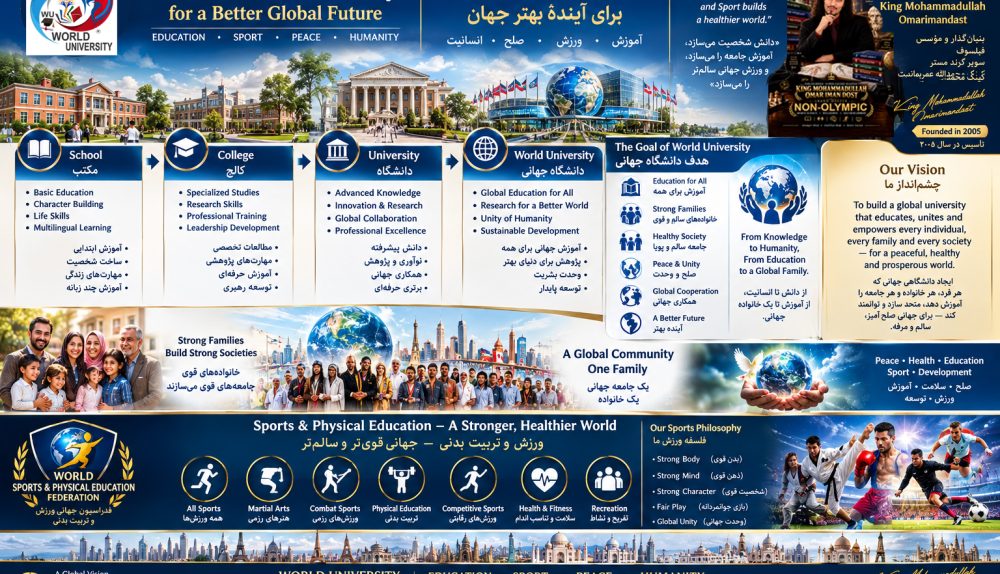
Founder: Philosopher Super Grand Master King Mohammadullah Omar Iman Dost
Institutional Name: World System of Sports, Science and Philosophy
Abbreviation: WSSSP
Institutional Character: International, multidisciplinary, scientific, philosophical, educational, academic and sports-oriented system
Proposed Global Scope: Five continents, international representatives, educational institutions, sports organizations, researchers, philosophers, coaches, students and practitioners
Founding Vision: A Sound Mind in a Healthy Body — Scientific Knowledge, Philosophical Wisdom and Physical Excellence.
Founding Date and International Seminar: 20 February, as declared by the founder; the year and documentary particulars should be inserted into the official historical record.
Official Document: Founding Constitution, Institutional Statute, Academic Regulations and International Committee Framework
PREAMBLE
We, the proponents, scholars, sports practitioners, educators, philosophers, researchers and representatives associated with the World System of Sports, Science and Philosophy, hereby establish this comprehensive constitutional framework to articulate the principles, objectives, academic philosophy, institutional organization, educational programs and international aspirations of the WSSSP.
The World System of Sports, Science and Philosophy is conceived as an integrated intellectual and educational framework through which the study of sport is connected with human movement, physical education, exercise science, psychology, philosophy, ethics, social development, history, technology and the cultivation of the human mind.
The system recognizes that sport is not merely a physical activity or competitive undertaking. It is also a field of scientific investigation, philosophical reflection, cultural expression, educational development, social cooperation and personal discipline.
Its central educational principle is:
“A sound mind in a healthy body: the harmonious development of physical strength, intellectual ability, ethical character and philosophical understanding.”
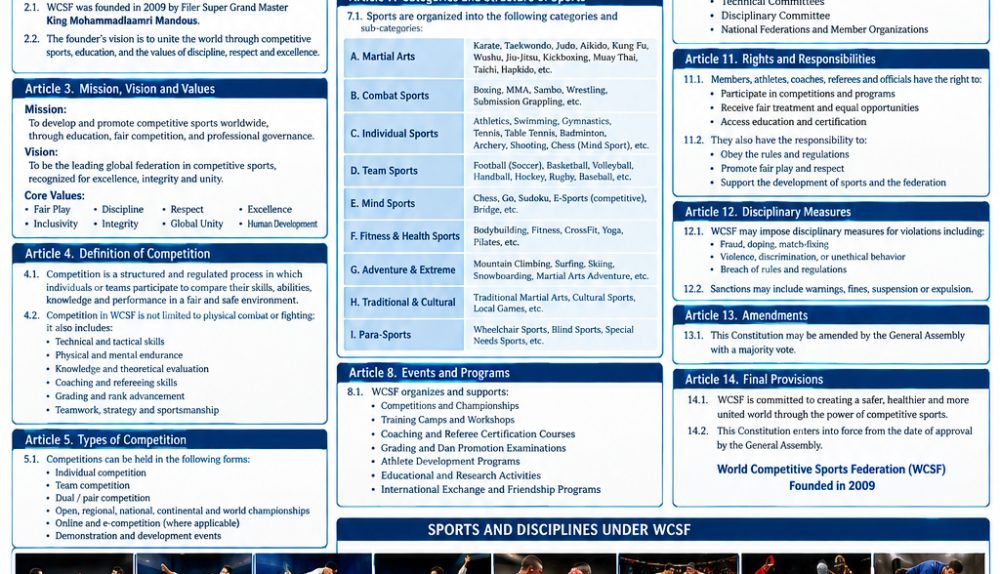
The system seeks to study the development of human movement from its earliest forms to contemporary physical activity, organized games, traditional sports, modern sports, Olympic sports, non-Olympic sports, adaptive sports and emerging forms of physical competition.
It further seeks to create an organized international platform for scientific seminars, philosophical discussions, academic instruction, structured examinations, research, publications, professional development and cooperation among participants from different countries and cultures.
The founder of this system is identified as Philosopher Super Grand Master King Mohammadullah Omar Iman Dost, whose founding vision, leadership and declared institutional initiative form the basis of this proposed constitutional document.
The WSSSP shall pursue its objectives through intellectual independence, scientific evidence, philosophical inquiry, academic integrity, respect for human dignity, equal opportunity, international cooperation and responsible institutional governance.
This Constitution establishes the foundational principles under which the system may develop its educational activities, committees, courses, seminars, examinations, research programs and international representative network.
CHAPTER I — NAME, IDENTITY AND FOUNDATIONAL STATUS
Article 1. Official Name
The official name of the institution shall be:
World System of Sports, Science and Philosophy (WSSSP).
The institution may use this name in its constitution, academic programs, seminars, publications, research projects, conferences and other authorized institutional activities, subject to applicable law and protection of relevant intellectual property.
Article 2. Institutional Identity
The WSSSP is an interdisciplinary educational and intellectual system dedicated to the comprehensive study of sport through scientific, philosophical, academic, historical, physical, psychological and social perspectives.
It shall seek to connect the practical experience of physical activity with theoretical knowledge, critical thinking, research methodology and ethical responsibility.
Article 3. Founder
The founder of the system is:
Philosopher Super Grand Master King Mohammadullah Omar Iman Dost
The founder’s name and title may appear on the founding charter, historical records, authorized institutional publications and official descriptions of the system.
The exact spelling, transliteration and official presentation of the founder’s name shall be standardized in the institution’s records.
Article 4. Founding Authority and Historical Record
The institution shall maintain a permanent founding record containing, where available:
- The founder’s declaration and founding documents.
- The original statement of institutional objectives.
- The date and location of founding activities.
- Records of international seminars and conferences.
- Lists of participating representatives and their respective organizations.
- Seminar programs, attendance records and minutes.
- Documentary evidence of endorsements, affiliations or formal recognition.
The founder’s historical role shall be acknowledged in institutional materials in accordance with the available founding documentation.
Article 5. International Character
The WSSSP aspires to operate internationally through cooperation with representatives, educators, researchers, sports professionals and partner organizations across the five continents.
Its international development shall be based on transparent governance, voluntary participation, lawful activities and mutually respectful cooperation.
Article 6. Institutional Independence
The WSSSP shall maintain intellectual independence and shall not discriminate against participants on the basis of nationality, ethnicity, sex, disability, social background, political opinion or other status protected by applicable law.
Its educational and research activities shall respect academic freedom, scientific criticism and the right to question established theories.
CHAPTER II — VISION, MISSION AND PHILOSOPHICAL FOUNDATIONS
Article 7. Vision
The long-term vision of the WSSSP is to develop a comprehensive international framework for understanding sport as a multidimensional field of human knowledge and practice.
The system aims to promote a world in which physical development is accompanied by intellectual growth, scientific literacy, philosophical understanding, ethical conduct and social responsibility.
Article 8. Mission
The mission of the WSSSP shall be to:
- Study sport from its historical origins to contemporary practice.
- Integrate sports science with philosophical and ethical inquiry.
- Promote scientific seminars and structured educational programs.
- Establish clear academic curricula, examinations and assessment standards.
- Encourage research, publications and international scholarly dialogue.
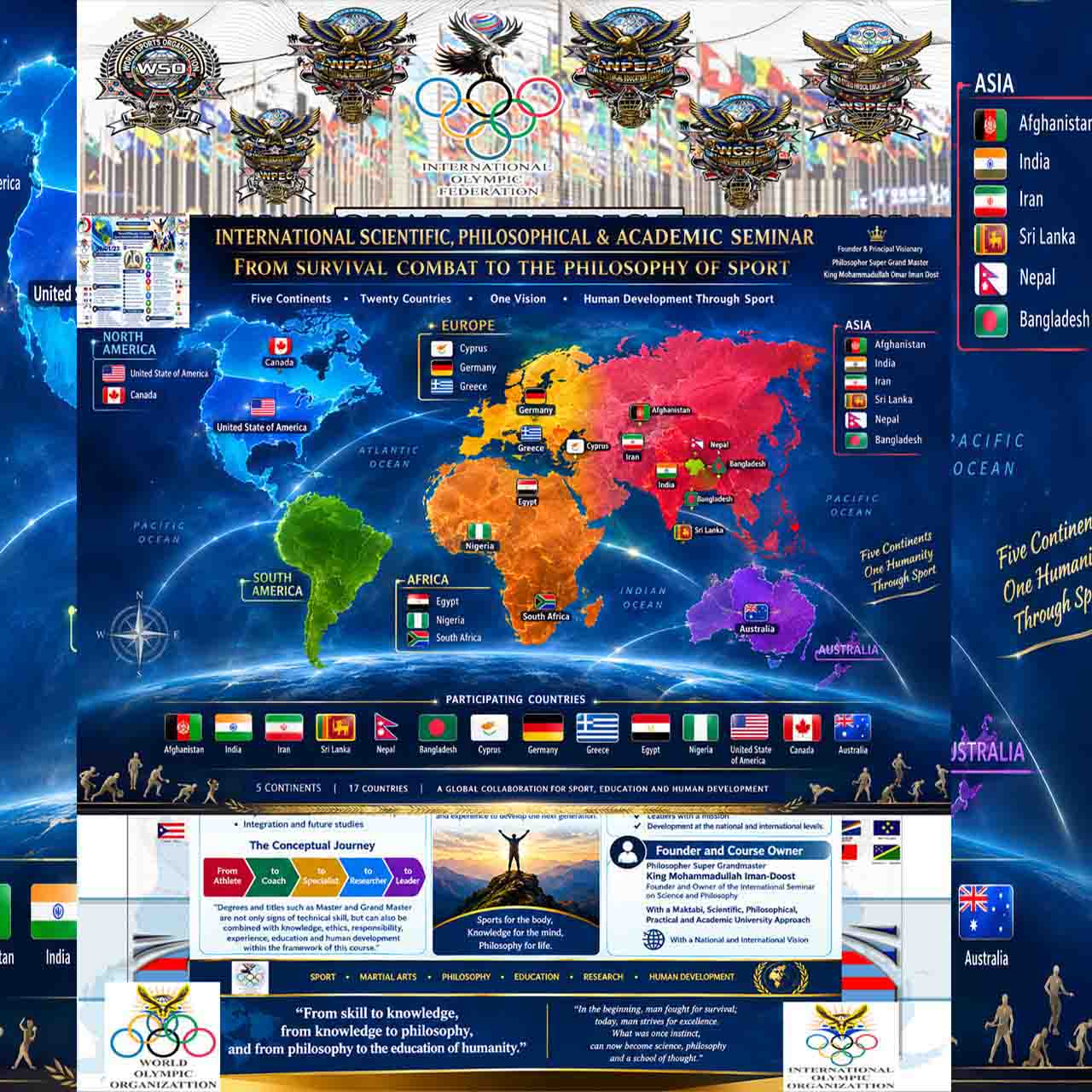
- Promote physical literacy, lifelong physical activity and health-conscious practice.
- Support the professional development of coaches, instructors, researchers and educators.
- Examine the social, cultural, psychological and technological dimensions of sport.
- Encourage cooperation among institutions and representatives in different countries.
- Develop an educational culture in which physical ability and intellectual ability are cultivated together.
Article 9. Central Philosophical Principle
The guiding principle of the WSSSP is:
“The body must be trained, the mind must be educated, reason must be cultivated, and character must be developed.”
This principle expresses the institution’s commitment to balanced human development.
It does not suggest that physical fitness automatically produces intelligence or that intellectual ability depends solely on bodily health. Rather, it recognizes physical, cognitive, emotional, social and ethical development as complementary dimensions of human flourishing.
Article 10. Scientific Foundation
The WSSSP shall encourage the use of established scientific methods, peer review where appropriate, transparent research practices, critical evaluation of evidence and clear distinctions between empirical findings and philosophical interpretations.
Scientific claims concerning exercise, health, performance, psychology and human physiology shall be assessed in accordance with relevant evidence and professional standards.
Article 11. Philosophical Foundation
The philosophical framework shall include the study of:
- The nature and meaning of sport.
- The relationship between body and mind.
- Human movement and embodiment.
- Ethics, fairness and responsibility.
- Freedom, discipline and self-development.
- Competition, cooperation and excellence.
- The social meaning of victory and defeat.
- The role of sport in human culture and civilization.
- The relationship between knowledge, wisdom and practical action.
Article 12. Educational Philosophy
Education within the WSSSP shall combine theoretical instruction, practical application, discussion, reflection, research, supervised learning and formal assessment.
The system shall seek to develop not merely the ability to reproduce information but also the capacity to analyze evidence, formulate arguments, solve problems and apply knowledge responsibly.
CHAPTER III — GENERAL OBJECTIVES AND SCOPE OF STUDY
Article 13. Comprehensive Scope
The WSSSP shall approach sport as a broad field encompassing human movement, exercise, physical education, recreation, organized games, athletic competition, performance science and the cultural institutions surrounding sport.
Article 14. Human Movement and Physical Activity
The system shall study human movement from early human physical activity to modern scientific understandings of movement and exercise.
Topics shall include:
- Human locomotion and movement patterns.
- Walking, running, jumping, climbing, throwing and carrying.
- Physical activities associated with survival, work and daily life.
- Traditional games and community recreation.
- The development of structured physical education.
- The emergence of organized competitions.
- The scientific analysis of human movement.
- Contemporary approaches to physical literacy and lifelong activity.
Historical interpretations shall be supported by archaeological, anthropological, historical and scientific evidence where available.
Article 15. Sports Science
The institution shall promote the study of exercise physiology, biomechanics, motor learning, sports psychology, sports nutrition, performance analysis, training methodology, injury prevention and related disciplines.
Article 16. Sports Philosophy
The institution shall investigate the conceptual foundations of sport, the nature of athletic excellence, ethical obligations, fairness, human limitations, competition and the role of sport in a meaningful life.
Article 17. Sports History
The institution shall encourage the comparative study of ancient games, traditional sporting practices, the development of organized sport, modern international competitions and the evolution of sporting institutions.
Article 18. Olympic and Non-Olympic Sports
The WSSSP shall study Olympic sports, non-Olympic sports, professional sports, amateur sports, traditional sports, emerging sports, recreational activities and other recognized forms of athletic practice.
The institution shall not treat Olympic inclusion as the sole measure of a sport’s cultural, educational or scientific importance.
Article 19. Modern and Emerging Sports
The system may examine esports where relevant to its broader definition of sport, as well as technology-assisted competition, wearable performance monitoring, data analytics, virtual training environments and other emerging developments.
Such subjects shall be assessed according to their particular physical, cognitive, social and competitive characteristics.
Article 20. Inclusive and Adaptive Sports
The WSSSP shall encourage the study and development of adaptive physical activity, Paralympic sports, inclusive physical education, disability-aware coaching and accessible sporting environments.
Article 21. Sports and Society
The system shall examine sport in relation to culture, education, economics, law, media, politics, public health, gender equality, social inclusion and international relations.
Article 22. Global Knowledge Framework
The WSSSP may develop a comprehensive classification of sporting disciplines, movements, training methods, philosophical approaches and research fields.
This classification shall remain open to revision as scientific knowledge and sporting practices evolve.
CHAPTER IV — ACADEMIC AND SCIENTIFIC DISCIPLINES
Article 23. Core Academic Divisions
The WSSSP shall organize its educational and research activities into the following principal divisions.
Division A: Physical Education and Human Movement
Study of physical literacy, movement development, exercise participation and the foundations of physical education.
Division B: Exercise Physiology and Health
Study of the physiological responses and adaptations associated with physical activity, exercise and athletic training.
Division C: Biomechanics and Kinesiology
Study of movement mechanics, force, balance, coordination, motor control and performance analysis.
Division D: Sports Psychology and Cognitive Science
Study of motivation, attention, learning, emotional regulation, decision-making, team dynamics and psychological preparation.
Division E: Sports Philosophy and Ethics
Study of philosophical concepts, moral reasoning, fairness, sporting integrity, human excellence and the meaning of competition.
Division F: Sports History and Civilization
Study of the origins, development and cultural significance of physical activity, games and organized sports.
Division G: Sports Pedagogy and Coaching
Study of teaching methods, coaching theory, instructional design, athlete development and educational assessment.
Division H: Sports Medicine and Injury Prevention
Study of sports-related health, injury prevention, rehabilitation principles and the boundaries of responsible professional practice.
Medical diagnosis and treatment shall remain within the authority of appropriately qualified healthcare professionals.
Division I: Sports Nutrition and Recovery
Study of nutrition, hydration, recovery, sleep and evidence-based approaches to supporting athletic performance and general health.
Division J: Sports Management and Administration
Study of governance, organizational leadership, event management, strategic planning, finance, communication and institutional development.
Division K: Olympic, International and Traditional Sports
Study of international sporting systems, traditional games, competitive formats, sporting rules and the historical evolution of athletic disciplines.
Division L: Sports Technology and Innovation
Study of performance analytics, digital tools, equipment, wearable technologies and the responsible use of data in sport.
Division M: Social, Cultural and Educational Studies
Study of sport as a social institution, its educational potential, its cultural diversity and its influence on communities.
Division N: Adaptive Sports and Inclusive Practice
Study of accessible sports, adapted training, inclusive coaching and participation across diverse abilities.
Division O: Research Methods and Academic Writing
Study of research design, evidence evaluation, statistics, academic writing, literature reviews, research ethics and scholarly publication.
Article 24. Interdisciplinary Research
The WSSSP shall encourage collaboration among its divisions.
Research projects may combine physiology and psychology, philosophy and coaching, history and sociology, technology and biomechanics, or other relevant disciplines.
Article 25. Academic Standards
Each academic program shall define its learning outcomes, course content, instructional hours, assessment methods, entry requirements and completion criteria.
Programs shall distinguish introductory education from advanced professional training and research-level study.
The use of terms such as academic, university-level, professional or accredited shall accurately reflect the actual status of the program and the institution’s legal authority.
CHAPTER V — INTERNATIONAL GOVERNANCE AND ORGANIZATIONAL STRUCTURE
Article 26. General Institutional Structure
The proposed organizational structure of the WSSSP shall consist of the following bodies:
- Founder and Founding Office.
- International Supreme Council.
- International Executive Council.
- Academic and Scientific Council.
- International Committee Secretariat.
- International Research Directorate.
- International Education and Certification Directorate.
- Continental Coordination Offices.
- National Representative Offices.
- Independent Ethics and Appeals Panel.
The precise legal powers, membership, election procedures and reporting relationships of these bodies shall be defined in implementing regulations.
Article 27. Founder and Founding Office
The Founder’s Office shall preserve the founding vision, historical documents, institutional identity and original declarations of the WSSSP.
The founder may serve as the founding chair or honorary founding authority, subject to the institution’s adopted governance rules and applicable law.
The office shall not be exempt from lawful financial oversight, safeguarding requirements or other mandatory institutional obligations.
Article 28. International Supreme Council
The International Supreme Council shall serve as the principal strategic and constitutional oversight body.
Its responsibilities may include:
- Reviewing institutional policy.
- Approving long-term strategic plans.
- Reviewing annual institutional reports.
- Considering proposed constitutional amendments.
- Supervising the implementation of international objectives.
- Ensuring that governance remains consistent with the founding principles.
The council’s membership, voting rights and appointment procedures shall be published in its governing regulations.
Article 29. International Executive Council
The Executive Council shall coordinate the practical administration of the system.
Its responsibilities shall include program implementation, operational planning, budget administration, coordination between departments and preparation of annual reports.
Article 30. Academic and Scientific Council
The Academic and Scientific Council shall oversee curricula, academic quality, research standards, examination procedures, scholarly publications and the qualifications required of instructors and examiners.
Its membership should include appropriately qualified professionals in relevant disciplines.
Article 31. International Secretariat
The Secretariat shall maintain institutional correspondence, meeting minutes, membership records, official communications, seminar documentation and administrative archives.
It shall maintain accurate records of international participation and institutional decisions.
Article 32. Continental Coordination Offices
The WSSSP may establish coordination offices or appoint representatives for:
- Africa.
- Asia.
- Europe.
- North America.
- South America.
- Oceania, including Australia and the Pacific region.
The institution may also establish cross-regional structures where this is more practical.
Article 33. National Representatives
National representatives may coordinate local seminars, identify potential academic partners, communicate institutional policies and report on educational activities within their respective jurisdictions.
Appointments shall be documented in writing and shall specify the representative’s authority, term, responsibilities and limitations.
A representative’s appointment shall not, by itself, establish government recognition, university accreditation or legal authority to issue regulated professional qualifications.
Article 34. Independent Oversight
The institution shall develop procedures for reviewing complaints, investigating misconduct, resolving disputes, addressing conflicts of interest and protecting the integrity of its examinations and certificates.
CHAPTER VI — INTERNATIONAL COMMITTEES
Article 35. General Committee Framework
The WSSSP shall establish specialist committees to support its academic, scientific, philosophical, administrative and international objectives.
Each committee shall have written terms of reference, defined responsibilities, an appointed chair, a reporting process and an annual work plan.
Article 36. Committee of Constitutional Affairs and Institutional Governance
Responsibilities:
- Reviewing the Constitution and institutional regulations.
- Advising on governance procedures.
- Maintaining records of approved amendments.
- Supporting compliance with applicable laws.
- Reviewing the division of responsibilities between institutional bodies.
Article 37. Committee of Sports Science and Research
Responsibilities:
- Promoting evidence-based research.
- Developing research priorities.
- Encouraging interdisciplinary scientific projects.
- Reviewing scientific presentations.
- Supporting research methodology and responsible data use.
Article 38. Committee of Philosophy and Intellectual Development
Responsibilities:
- Developing philosophical curricula.
- Organizing discussions on body, mind, reason and human development.
- Studying the ethical foundations of sport.
- Encouraging critical thinking and philosophical debate.
- Promoting respectful dialogue among different intellectual traditions.
Article 39. Committee of Academic Education and Curriculum
Responsibilities:
- Designing course structures.
- Defining learning outcomes.
- Establishing minimum instructional standards.
- Reviewing course materials.
- Recommending instructor qualifications.
- Monitoring educational quality.
Article 40. Committee of Seminars and International Conferences
Responsibilities:
- Planning international scientific seminars.
- Preparing academic programs and schedules.
- Coordinating speakers and moderators.
- Maintaining participant registers.
- Collecting presentations and proceedings.
- Evaluating seminar quality.
Article 41. Committee of Examinations and Academic Assessment
Responsibilities:
- Developing examination regulations.
- Preparing written and practical assessments.
- Establishing marking rubrics.
- Protecting examination confidentiality.
- Supervising invigilation and academic integrity.
- Reviewing appeals and assessment irregularities.
Article 42. Committee of Certification and Academic Records
Responsibilities:
- Maintaining accurate examination and completion records.
- Verifying eligibility for certificates.
- Establishing certificate numbering and verification procedures.
- Recording course duration and learning outcomes.
- Preventing false or misleading credential claims.
Article 43. Committee of Human Movement and Physical Activity
Responsibilities:
- Studying fundamental movement patterns.
- Developing physical literacy curricula.
- Examining the historical development of human movement.
- Promoting safe and inclusive participation.
- Connecting movement science with educational practice.
Article 44. Committee of Olympic and International Sports
Responsibilities:
- Studying Olympic and international sporting systems.
- Comparing sporting disciplines and regulations.
- Examining athlete development and international competition.
- Promoting understanding of the cultural significance of global sport.
Article 45. Committee of Traditional and Non-Olympic Sports
Responsibilities:
- Documenting traditional games and sporting practices.
- Studying non-Olympic sporting disciplines.
- Preserving cultural sporting knowledge.
- Encouraging respectful exchange among communities.
Article 46. Committee of Sports Ethics and Integrity
Responsibilities:
- Promoting fairness, respect and sportsmanship.
- Addressing cheating, corruption and conflicts of interest.
- Developing anti-harassment and safeguarding policies.
- Encouraging responsible treatment of athletes.
- Supporting ethical decision-making in education and competition.
Article 47. Committee of Sports Psychology and Mental Development
Responsibilities:
- Studying motivation and concentration.
- Examining learning, decision-making and performance.
- Developing educational content on psychological skills.
- Encouraging responsible mental preparation.
- Distinguishing educational instruction from clinical psychological treatment.
Article 48. Committee of Coaching and Professional Development
Responsibilities:
- Developing coaching curricula.
- Promoting safe instructional practice.
- Supporting continuing professional education.
- Evaluating practical teaching skills.
- Encouraging reflective and evidence-based coaching.
Article 49. Committee of Sports Medicine, Safety and Recovery
Responsibilities:
- Promoting injury prevention education.
- Developing safety guidance for physical activities.
- Supporting appropriate referral to healthcare professionals.
- Encouraging evidence-based recovery practices.
- Establishing safety requirements for practical demonstrations.
Article 50. Committee of Inclusion and Adaptive Sports
Responsibilities:
- Promoting accessibility.
- Supporting disability-inclusive programs.
- Encouraging adapted sporting activities.
- Reviewing barriers to participation.
- Promoting equal educational opportunity.
Article 51. Committee of Technology, Innovation and Digital Learning
Responsibilities:
- Developing digital educational resources.
- Studying performance technology.
- Supporting responsible use of artificial intelligence and analytics.
- Promoting data protection and digital security.
- Evaluating new methods of online and blended instruction.
Article 52. Committee of Publications and Scientific Communication
Responsibilities:
- Preparing academic publications.
- Editing seminar proceedings.
- Establishing publication ethics.
- Supporting multilingual communication.
- Encouraging citation, attribution and responsible dissemination of research.
Article 53. Committee of International Relations and Partnerships
Responsibilities:
- Developing cooperation with educational and sporting institutions.
- Coordinating international correspondence.
- Exploring lawful academic partnerships.
- Maintaining records of memoranda of understanding.
- Distinguishing informal cooperation from formal recognition or accreditation.
Article 54. Committee of Finance, Audit and Administration
Responsibilities:
- Preparing budgets.
- Maintaining financial records.
- Establishing procurement procedures.
- Supporting independent financial review.
- Disclosing conflicts of interest.
- Promoting responsible stewardship of institutional resources.
Article 55. Committee of Membership and National Representation
Responsibilities:
- Managing membership applications.
- Verifying representative appointments.
- Maintaining membership registers.
- Establishing categories of membership.
- Supporting transparent renewal and termination procedures.
Article 56. Committee of Legal Affairs and Compliance
Responsibilities:
- Reviewing relevant legal obligations.
- Advising on registration, contracts and intellectual property.
- Reviewing the lawful use of titles and credentials.
- Supporting appropriate data-protection practices.
- Advising on jurisdiction-specific education and professional regulations.
Article 57. Committee of Youth, Education and Community Sport
Responsibilities:
- Promoting youth participation.
- Supporting age-appropriate educational programs.
- Developing community outreach.
- Promoting safeguarding and child protection.
- Encouraging lifelong engagement in physical activity.
Article 58. Committee of Monitoring, Evaluation and Quality Assurance
Responsibilities:
- Measuring program effectiveness.
- Reviewing participant feedback.
- Evaluating learning outcomes.
- Monitoring committee performance.
- Publishing periodic quality reports.
- Recommending improvements to institutional policy.
CHAPTER VII — INTERNATIONAL SEMINARS AND SCIENTIFIC CONFERENCES
Article 59. Purpose of Seminars
The WSSSP shall organize specialist seminars designed to develop scientific knowledge, philosophical understanding, academic discussion and practical competence in sport.
Seminars shall provide structured opportunities for participants to learn from researchers, educators, philosophers, coaches and qualified professionals.
Article 60. Seminar Categories
The institution may organize:
- Introductory seminars.
- Specialist scientific seminars.
- Advanced academic seminars.
- Philosophical discussion seminars.
- International multidisciplinary conferences.
- Practical workshops.
- Research methodology seminars.
- Instructor development seminars.
- Examination preparation sessions.
- Continuing professional education seminars.
Article 61. Seminar Duration
Seminars may be organized as one-day, multi-day, weekly, monthly or other clearly defined educational events.
A seminar lasting one month shall have a published schedule specifying the instructional days, contact hours, subject matter, learning objectives and assessment requirements.
Article 62. International Participation
The institution’s founding narrative records participation by representatives from 55 countries across five continents in connection with an international specialist scientific and philosophical seminar beginning on 20 February and described as lasting one month.
The year, venue, participant list, affiliations, attendance records and supporting documents shall be entered into the official historical archive when available.
Any claim of participation or institutional endorsement shall accurately reflect the available evidence.
Article 63. Seminar Program Requirements
Every official seminar shall have:
- An approved title.
- A statement of objectives.
- A detailed academic program.
- A list of speakers and their relevant qualifications.
- A defined participant profile.
- A schedule of sessions.
- A record of attendance.
- Appropriate educational materials.
- Assessment procedures, where applicable.
- A completion and evaluation report.
Article 64. Seminar Teaching Methods
Instruction may include lectures, presentations, guided discussion, case studies, practical demonstrations, supervised exercises, written assignments, group projects and research presentations.
Article 65. Seminar Proceedings
Where appropriate, the institution may publish proceedings containing abstracts, papers, presentations, participant contributions and conclusions.
All publications shall follow transparent editorial standards and obtain appropriate permissions.
Article 66. International Recognition of Seminars
The WSSSP may document participation, endorsements, partnerships or formal recognition associated with its seminars.
The expression internationally recognized shall be used with an identified basis, such as a documented institutional endorsement, formal agreement or recognition by a competent authority.
Participation by representatives from multiple countries shall not, by itself, be described as accreditation by governments, universities or international sports governing bodies.
CHAPTER VIII — EDUCATIONAL PROGRAMS AND COURSE DURATIONS
Article 67. General Educational Structure
The WSSSP shall establish a structured system of courses ranging from introductory study to advanced professional development and research-oriented education.
Each course shall have clearly defined entry requirements, learning outcomes, content, instructional hours, assessment methods and completion requirements.
Article 68. One-Month Program
Duration: One month.
Proposed level: Introductory or intensive foundation program.
Possible subjects:
- Introduction to the WSSSP.
- Foundations of sport and human movement.
- Introduction to sports science.
- Introduction to sports philosophy.
- Basic research literacy.
- Sports ethics and safety.
- Final written examination.
The course shall specify the total number of instructional hours. Its short duration shall not be presented as equivalent to a university degree or a comprehensive professional qualification.
Article 69. Three-Month Program
Duration: Three months.
Proposed level: Foundation certificate program.
Possible subjects:
- Fundamentals of physical activity.
- Basic exercise science.
- Introduction to biomechanics.
- Foundations of sports psychology.
- Sports history and culture.
- Philosophical approaches to sport.
- Research and academic writing.
- Written examination and a final assignment.
Article 70. Six-Month Program
Duration: Six months.
Proposed level: Intermediate certificate or structured professional-development program, subject to the curriculum and applicable rules.
Possible subjects:
- Exercise physiology.
- Movement analysis.
- Sports pedagogy.
- Training principles.
- Sports psychology.
- Sports ethics.
- Introduction to sports management.
- Research methodology.
- Practical assessment, where appropriate.
- Final written and/or practical examination.
Article 71. One-Year Program
Duration: Twelve months.
Proposed level: Comprehensive foundation or advanced certificate program.
Possible structure:
- Semester One: Foundations of sports science, human movement, history and philosophy.
- Semester Two: Applied sports science, coaching principles, ethics, research methods and specialized study.
- Final assessment: Written examination, project or practical evaluation according to the approved curriculum.
The qualification awarded shall accurately reflect the institution’s legal status and the actual learning completed.
Article 72. Two-Year Program
Duration: Twenty-four months.
Proposed level: Extended professional-development or advanced diploma-style program, where legally permitted.
Possible components:
- Core sports science.
- Applied biomechanics and physiology.
- Sports psychology and pedagogy.
- Philosophy and ethics of sport.
- Research methods and academic writing.
- Specialized sporting discipline.
- Supervised practical learning, where appropriate.
- Capstone project or equivalent final assessment.
The use of diploma shall comply with applicable education regulations and shall not imply government recognition unless that recognition has been obtained.
Article 73. Four-Year Program
Duration: Forty-eight months.
Proposed level: Comprehensive long-term academic program.
Possible structure:
Year One — Foundations
Human movement, physical education, sports history, introductory philosophy, scientific literacy and research foundations.
Year Two — Scientific Development
Exercise physiology, biomechanics, motor learning, sports psychology, coaching methodology and quantitative methods.
Year Three — Specialization
Advanced study in a selected discipline, sports ethics, management, performance analysis, research design and supervised field experience where appropriate.
Year Four — Research and Integration
Advanced interdisciplinary study, research project, dissertation-style work where appropriate, final examinations and presentation of findings.
A four-year course does not automatically constitute a bachelor’s degree. Degree-awarding status requires the relevant legal authorization or an appropriately accredited academic partnership.
Article 74. Curriculum Approval
All programs shall be reviewed by the Academic and Scientific Council before implementation.
The review shall address:
- Learning outcomes.
- Subject coverage.
- Teaching methods.
- Instructor qualifications.
- Instructional hours.
- Assessment methods.
- Student support.
- Safety and safeguarding.
- Academic integrity.
- Program evaluation.
Article 75. Credit and Contact Hours
Where credit hours are used, the institution shall publish its calculation method and distinguish classroom contact hours, independent study, practical training and supervised placement.
Credits shall not be described as transferable university credits unless the relevant receiving institution or recognized framework confirms their acceptance.
CHAPTER IX — EXAMINATIONS AND ACADEMIC ASSESSMENT
Article 76. Examination Principle
The WSSSP shall use examinations to assess participants’ understanding, analytical ability, application of knowledge and achievement of defined learning outcomes.
The examination system shall be transparent, consistent, fair and appropriate to the level of each program.
Article 77. Types of Examination
The institution may conduct:
- Written examinations.
- Multiple-choice examinations.
- Short-answer examinations.
- Essay examinations.
- Oral examinations.
- Practical assessments.
- Research presentations.
- Case-study analysis.
- Project-based assessment.
- Final comprehensive examinations.
Article 78. Official Examination Paper
At the conclusion of designated seminars and courses, participants may receive an official examination paper prepared and approved by the responsible academic committee.
Each examination paper shall include, as appropriate:
- The institution’s official name and emblem.
- The examination title.
- Course or seminar title.
- Examination date.
- Candidate identification number or approved identifier.
- Duration.
- Total marks.
- Instructions to candidates.
- Questions and allocated marks.
- Examiner or authorized signatory details.
The paper shall be distributed under appropriate examination conditions.
Article 79. Examination Administration
The responsible committee shall establish procedures for candidate registration, attendance verification, distribution of examination papers, invigilation, collection of answer scripts, marking and result publication.
Article 80. Marking and Pass Requirements
Every examination shall have a published marking scheme.
Unless a program adopts another documented standard, a proposed grading framework may use a pass threshold of 60 percent.
The institution shall specify whether attendance, practical competence, assignments and examinations are individually mandatory or contribute to an overall final grade.
Article 81. Academic Integrity
Participants shall complete examinations honestly.
Plagiarism, impersonation, unauthorized assistance, falsification of results and other forms of academic misconduct shall be addressed under published disciplinary procedures.
Article 82. Examination Appeals
Participants shall have access to a documented process for requesting a review of a result.
Appeals shall be reviewed by an authorized person or panel that was not responsible for the original decision wherever practicable.
Article 83. Examination Records
The institution shall maintain secure records of examinations, results, grading decisions, appeals and certificate eligibility in accordance with applicable data-protection and record-retention requirements.
CHAPTER X — CERTIFICATES AND QUALIFICATIONS
Article 84. Certificate Eligibility
A certificate shall be issued only when the participant has satisfied the published requirements for the relevant course or seminar.
Where examinations are mandatory, attendance alone shall not be sufficient for an examination-based certificate.
Article 85. Types of Certificate
The WSSSP may establish the following categories, subject to applicable law:
- Certificate of Attendance.
- Certificate of Participation.
- Certificate of Completion.
- Certificate of Successful Examination.
- Certificate of Achievement.
- Certificate of Continuing Professional Education.
- Certificate of Research Presentation.
- Instructor Development Certificate.
- Advanced Program Completion Certificate.
Article 86. Certificate Content
An official certificate should state:
- The full name of the institution.
- The participant’s name.
- The course or seminar title.
- The actual duration or instructional hours.
- The date of completion.
- Whether an examination was passed, where applicable.
- A unique certificate number.
- The authorized signature.
- The issuing organization’s contact or verification information.
- Any necessary statement concerning the certificate’s scope and status.
Article 87. Verification and Authenticity
The WSSSP shall maintain a certificate-verification procedure that enables authorized parties to confirm the authenticity of issued certificates while protecting participants’ personal information.
Certificates shall not imply qualifications, professional licenses or academic degrees that the institution is not legally authorized to confer.
Article 88. International Use
Participants may present their certificates to employers, sporting organizations or educational institutions for consideration.
Acceptance, equivalency or recognition by external institutions shall remain subject to those institutions’ own requirements and applicable laws.
CHAPTER XI — RESEARCH, PUBLICATIONS AND KNOWLEDGE DEVELOPMENT
Article 89. Research Mission
The WSSSP shall promote research that advances understanding of sport, physical activity, human movement, cognition, ethics, education and society.
Article 90. Research Standards
Research shall follow appropriate methodological standards, honest reporting, responsible data handling, proper attribution and applicable ethical review requirements.
Article 91. Research Topics
Research may address:
- Human movement and physical activity.
- Exercise and physiological adaptation.
- Biomechanics and motor learning.
- Psychological factors in sport.
- Sports philosophy and ethical decision-making.
- History and cultural traditions.
- Coaching and educational methods.
- Adaptive and inclusive sports.
- Technology and performance analytics.
- Sport, society and international cooperation.
Article 92. Publications
The institution may publish journals, monographs, textbooks, seminar proceedings, research reports, educational manuals and digital learning materials.
Publications shall clearly identify their authors, editors, publication dates and review processes.
Article 93. Research Collaboration
The WSSSP may collaborate with qualified researchers and lawful academic partners through joint projects, conferences, educational exchanges and research agreements.
Any claimed partnership shall be supported by a genuine agreement or other verifiable evidence.
CHAPTER XII — MEMBERSHIP AND INTERNATIONAL REPRESENTATION
Article 94. Membership Categories
The WSSSP may establish the following categories:
- Founding Member.
- Honorary Member.
- Academic Member.
- Research Member.
- Professional Member.
- Sports Practitioner Member.
- Student Member.
- Institutional Member.
- National Representative.
- International Committee Member.
The titles and privileges attached to each category shall be defined in the membership regulations.
Article 95. Membership Requirements
Membership shall be based on published eligibility requirements, a documented application process and transparent approval procedures.
Any professional qualifications required for a particular role shall be specified in advance.
Article 96. National Representatives
National representatives shall act within their written mandates and shall not make unauthorized claims concerning institutional accreditation, government endorsement, degree-awarding authority or international recognition.
Article 97. Rights of Members
Subject to their membership category and the governing regulations, members may:
- Participate in authorized institutional activities.
- Attend eligible seminars and conferences.
- Submit proposals and research contributions.
- Apply for committee positions.
- Receive institutional communications.
- Access educational resources permitted by their membership.
Article 98. Responsibilities of Members
Members shall comply with the Constitution, respect the rights of others, maintain academic integrity, protect confidential information and represent the institution accurately.
Article 99. Suspension and Termination
Membership may be suspended or terminated for substantiated misconduct, fraud, serious breaches of institutional rules or other grounds defined in published regulations.
A fair process shall provide notice of the allegations and an appropriate opportunity to respond.
CHAPTER XIII — ETHICS, SAFEGUARDING AND PROFESSIONAL RESPONSIBILITY
Article 100. General Ethical Code
All institutional activities shall respect human dignity, intellectual honesty, fairness, personal safety and responsible professional conduct.
Article 101. Respect and Non-Discrimination
Participants shall be treated fairly regardless of nationality, language, culture, sex, disability or other protected status.
Article 102. Athlete Welfare
The WSSSP shall promote appropriate training loads, injury prevention, respect for recovery, protection from abuse and referral to qualified professionals when necessary.
Article 103. Protection of Minors
Programs involving minors shall adopt appropriate safeguarding policies, supervision procedures, consent requirements and legally compliant background-check practices where applicable.
Article 104. Anti-Doping and Fair Competition
The institution shall promote clean sport, ethical competition and education concerning prohibited performance-enhancing practices.
Where relevant, educational materials should reflect the applicable rules of the competent sporting authority.
Article 105. Conflicts of Interest
Officers, committee members, examiners and representatives shall disclose relevant conflicts of interest and refrain from decisions in which impartiality may reasonably be compromised.
Article 106. Complaints and Disciplinary Procedures
The institution shall maintain confidential, accessible and impartial procedures for receiving complaints, investigating alleged misconduct and determining proportionate responses.
Article 107. Intellectual Property
Institutional publications, course materials, logos and educational resources shall be used in accordance with applicable intellectual property law and written permissions.
CHAPTER XIV — FINANCE, ADMINISTRATION AND TRANSPARENCY
Article 108. Financial Principles
The institution shall manage its finances responsibly, transparently and in accordance with applicable law.
Article 109. Sources of Funding
Permitted funding sources may include membership fees, lawful course fees, donations, grants, publication income, conference fees and other legitimate sources approved under institutional policy.
Article 110. Financial Records
The institution shall maintain records of income, expenditure, contracts, assets, liabilities and other relevant financial transactions.
Article 111. Budget Approval
An annual budget shall be prepared and approved by the body designated under the institution’s governance regulations.
Article 112. Audit and Financial Review
The institution shall adopt appropriate independent financial review or audit procedures based on its legal form, financial scale and applicable regulatory requirements.
Article 113. Transparency
Institutional reports should identify the responsible governing bodies, principal activities, financial oversight arrangements and material changes in organizational structure.
CHAPTER XV — QUALITY ASSURANCE AND CONTINUOUS DEVELOPMENT
Article 114. Academic Quality
Every educational program shall be reviewed periodically to ensure that its content, instructors, assessment methods and learning outcomes remain appropriate.
Article 115. Participant Feedback
Participants shall be offered suitable opportunities to evaluate course content, teaching methods, examinations and administrative support.
Article 116. Instructor Evaluation
The institution shall define appropriate requirements for instructor qualifications, subject competence, teaching ability and professional conduct.
Article 117. Institutional Performance Indicators
Where relevant, the institution may evaluate:
- Enrollment and completion rates.
- Examination outcomes.
- Participant satisfaction.
- Research and publication activity.
- Seminar participation.
- International collaboration.
- Accessibility and inclusion.
- Financial sustainability.
- Compliance with ethical and administrative requirements.
Article 118. Continuous Improvement
The relevant councils and committees shall use evaluation findings to improve educational quality, governance and institutional effectiveness.
CHAPTER XVI — INTERNATIONAL COOPERATION AND GLOBAL DEVELOPMENT
Article 119. International Cooperation
The WSSSP shall seek lawful cooperation with educational institutions, sports organizations, researchers, professional associations and other relevant bodies.
Article 120. Memoranda of Understanding
Formal partnerships shall be documented in written agreements that identify the participating parties, objectives, responsibilities, duration and applicable limitations.
Article 121. Continental and National Programs
Continental and national representatives may propose seminars, educational programs, research projects and community initiatives for approval under the relevant institutional procedures.
Article 122. Multilingual Education
The institution may develop educational materials in English and other languages to improve access to its programs.
Translations of constitutional, academic and examination documents shall preserve their intended meaning and be reviewed where necessary.
Article 123. International Events
International events shall be organized with appropriate planning, participant information, accessibility measures, financial controls and safety arrangements.
Article 124. Recognition and External Relations
The WSSSP shall accurately distinguish among:
- Its own institutional declarations.
- Participation by representatives from different countries.
- Formal partnerships with independent organizations.
- Endorsements by professional bodies.
- Accreditation or recognition by competent authorities.
No category shall be represented as another without supporting documentation.
CHAPTER XVII — INSTITUTIONAL PLANNING AND IMPLEMENTATION
Article 125. Strategic Development
The institution shall adopt a strategic plan identifying its educational priorities, organizational objectives, resource requirements and implementation timetable.
Article 126. Foundational Documentation
The following documents should be prepared and maintained:
- Constitution and institutional statute.
- Governance and election regulations.
- Academic and curriculum regulations.
- Examination and assessment regulations.
- Certificate and records policy.
- Membership regulations.
- Code of ethics and safeguarding policy.
- Financial management policy.
- Research ethics policy.
- Data protection and privacy policy.
- International representation policy.
- Quality assurance framework.
Article 127. Institutional Registration
Where required, the WSSSP shall obtain appropriate legal registration, licenses or authorizations in the jurisdiction in which it operates.
International aspirations shall not remove the requirement to comply with national laws.
Article 128. Operational Implementation
The institution shall implement its organizational structure in stages, according to its resources, legal status, staffing, documented membership and operational capacity.
Article 129. Official Communications
The institution shall identify authorized signatories and official communication channels.
Documents asserting institutional decisions, appointments, partnerships or recognition shall be issued only by persons authorized to do so.
CHAPTER XVIII — CONSTITUTIONAL AMENDMENTS AND FINAL PROVISIONS
Article 130. Amendment Proposals
Proposals to amend this Constitution may be submitted by the founder, the designated governing bodies or other eligible members as defined in the institutional regulations.
Article 131. Review of Amendments
Proposed amendments shall be reviewed for consistency with the founding mission, academic principles, ethical standards and applicable law.
Article 132. Approval of Amendments
Amendments shall be adopted through the voting or approval procedure established by the legally competent governing body.
The approved text, date of approval and responsible authority shall be recorded in the constitutional archive.
Article 133. Interpretation
Questions concerning the interpretation of this Constitution shall be referred to the designated constitutional authority, subject to applicable law and any legally binding external requirements.
Article 134. Severability
If any provision is found to be invalid or unenforceable under applicable law, the remaining provisions shall continue to apply to the extent legally permissible.
Article 135. Effective Date
This Constitution shall enter into force on the date formally approved by the competent founding or governing authority, subject to any legal requirements applicable to the institution.
Article 136. Official Languages
English shall serve as the principal language of this international charter unless the governing authority adopts additional official languages.
Official translations may be prepared to support international participation.
Article 137. Institutional Continuity
The institution shall maintain its historical archive, constitutional records, academic standards and governance documents to support continuity across future administrations.
Article 138. Final Declaration
The World System of Sports, Science and Philosophy is dedicated to the integrated study of physical activity, scientific knowledge, philosophical understanding and responsible human development.
Its purpose is to establish an organized educational framework through which the body, mind, intellect and character may be studied and developed in a complementary manner.
The system shall encourage the pursuit of truth through scientific inquiry, wisdom through philosophical reflection, excellence through disciplined practice and mutual respect through international cooperation.
The WSSSP shall seek to contribute to the development of sport as a field of knowledge, a form of education, a cultural institution and a means of personal and social development.
The body shall be cultivated through physical practice; the mind shall be strengthened through learning; reason shall be refined through inquiry; and character shall be developed through ethical conduct.
ANNEX I — PROPOSED INTERNATIONAL ORGANIZATIONAL CHART
Founder and Founding Office
↓
International Supreme Council
↓
International Executive Council
↓
Academic and Scientific Council
↓
International Secretariat and Specialist Directorates
↓
International Specialist Committees
↓
Continental Coordination Offices
↓
National Representatives and Approved Partner Institutions
↓
Seminars, Courses, Research Projects, Examinations and Educational Programs
This chart represents a proposed organizational model. The institution’s final governance structure should be approved formally and adjusted to its legal status and operational requirements.
ANNEX II — PROPOSED ACADEMIC PROGRAM MATRIX
| Program | Duration | Proposed educational purpose | Final assessment |
|---|---|---|---|
| Foundation Course | 1 month | Introduction to the system and core concepts | Written examination |
| Certificate Program | 3 months | Foundational knowledge and academic literacy | Written examination and assignment |
| Intermediate Program | 6 months | Broader scientific and philosophical study | Written and/or practical examination |
| Advanced Foundation Program | 1 year | Integrated interdisciplinary education | Comprehensive examination and project |
| Extended Professional Program | 2 years | Advanced study and applied learning | Examinations and capstone project |
| Comprehensive Academic Program | 4 years | Long-term interdisciplinary study and research | Final examinations and research project |
Important qualification: These are proposed program structures, not declarations that the WSSSP presently possesses authority to award regulated academic degrees or professionally licensed qualifications. Such authority must be established separately where required.
ANNEX III — PROPOSED ONE-MONTH SEMINAR STRUCTURE
Week One: Foundations of Human Movement
- Introduction to the WSSSP.
- Historical approaches to human movement.
- Physical activity and human development.
- Foundations of physical education.
- Introduction to sports history.
Week Two: Scientific Study of Sport
- Exercise physiology.
- Biomechanics and movement analysis.
- Sports psychology.
- Scientific research methods.
- Safety and responsible exercise practice.
Week Three: Philosophy, Ethics and Sporting Culture
- Philosophy of the body and mind.
- Sports ethics and fair competition.
- Traditional, Olympic and non-Olympic sports.
- Sport, education and society.
- International sporting cooperation.
Week Four: Integration and Academic Assessment
- Interdisciplinary presentations.
- Research and case-study discussions.
- Review of course materials.
- Final written examination.
- Evaluation and feedback.
- Completion records and eligible certificates.
The final timetable shall specify actual instructional hours, breaks, assessment arrangements and the qualifications of the instructors.
ANNEX IV — MODEL WRITTEN EXAMINATION PAPER
WORLD SYSTEM OF SPORTS, SCIENCE AND PHILOSOPHY
Specialist Scientific and Philosophical Seminar
Candidate Name: ______________________________
Candidate Number: ____________________________
Course or Seminar: ____________________________
Date: ________________________________________
Duration: 120 minutes, as proposed
Total Marks: 100
Section A — Multiple-Choice Questions
20 marks
Ten questions, each worth two marks.
Topics may include human movement, exercise science, sports history, philosophy and ethics.
Section B — Short-Answer Questions
20 marks
Four questions, each worth five marks.
Candidates should provide clear definitions and concise explanations of core concepts.
Section C — Analytical Questions
30 marks
Three questions, each worth ten marks.
Candidates should analyze a scientific, philosophical or practical issue and support their answers with appropriate reasoning.
Section D — Extended Essay
20 marks
Choose one question and write a structured response.
Example question: Explain how scientific knowledge and philosophical reflection can contribute to the responsible development of sport and human physical activity.
Section E — Applied Case Study
10 marks
Analyze a practical sporting situation, identify the relevant scientific or ethical principles, and recommend an evidence-based course of action.
Proposed pass mark: 60/100, subject to formal adoption in the examination regulations.
ANNEX V — MODEL CERTIFICATE TEXT
WORLD SYSTEM OF SPORTS, SCIENCE AND PHILOSOPHY
CERTIFICATE OF SUCCESSFUL COMPLETION
This document certifies that
[Participant’s Full Name]
has successfully completed the educational program entitled
[Official Course or Seminar Title]
with a stated duration of [Number of Hours / Course Duration], conducted by the World System of Sports, Science and Philosophy.
The participant has fulfilled the published attendance, coursework and assessment requirements applicable to this program.
Date of Completion: [Date]
Certificate Number: [Unique Verification Number]
Authorized Signatory: [Name and Position]
Institutional Verification: [Official Verification Details]
This certificate confirms completion of the stated program. Any claim of external accreditation, professional licensing or academic degree equivalency shall require separate authorization or recognition by the competent body.
ANNEX VI — PROPOSED FOUNDING RECORD
The institution shall prepare a verified historical record containing the following information:
Founder: Philosopher Super Grand Master King Mohammadullah Omar Iman Dost
Institution: World System of Sports, Science and Philosophy.
Reported Seminar Date: 20 February.
Reported Duration: One month.
Reported International Participation: Representatives from 55 countries across five continents.
Reported Subject Matter: Scientific, philosophical, academic and educational approaches to sport.
Documentation to Preserve:
- The year of the seminar.
- The venue and organizer.
- The official program.
- Attendance and participation records.
- Names and affiliations of participating representatives, where disclosure is appropriate.
- Minutes and conclusions.
- Photographs and other authentic records.
- Letters of endorsement or formal recognition, if any.
- Supporting evidence for claims of international institutional recognition.
The completed historical record should distinguish between documented participation, expressions of support, formal partnerships and legally recognized accreditation.
ANNEX VII — OFFICIAL INSTITUTIONAL MOTTO
A SOUND MIND IN A HEALTHY BODY
Science for Understanding. Philosophy for Wisdom. Sport for Human Development.
The World System of Sports, Science and Philosophy aspires to unite physical education, scientific investigation, philosophical reflection and ethical responsibility in a comprehensive educational vision.
Through structured seminars, academic programs, examinations, research, publications and international cooperation, the WSSSP seeks to contribute to a more informed, responsible and intellectually engaged global sporting community.
END OF FOUNDING CONSTITUTION AND INSTITUTIONAL STATUTE
World System of Sports, Science and Philosophy (WSSSP)
Founder: Philosopher Super Grand Master King Mohammad Ali Ameri Mandes
Prepared as a proposed institutional charter for formal review, adoption, registration and implementation.